Recycling
Range of services
Range of service
Fluctuating wastewater qualities, complex-forming substances, strict discharge limits.
High chemical consumption and sludge formation, foaming, scaling/corrosion, failures in IX/UO/UF.
A lack of process data and inconsistent dosing strategies make reliable, cost-optimized operation difficult.
Your problems
Dwindling freshwater reserves worldwide, stricter legal discharge limits and increasing demands for sustainable production pose major challenges for industrial companies. Especially in galvanic, anodizing, mechanical and chemical processes, the efficient use of water is crucial.
Our solutions
Zero Liquid Discharge (ZLD) offers one of the most effective solutions for almost completely eliminating waste water and recovering valuable process water. The precise interaction of all treatment steps results in a highly efficient recycling concept. Almost 100 % of the waste water becomes recycled process water.
The combination of various recycling and treatment technologies in the cascade creates a closed water cycle – with high operational reliability and significant savings in fresh water and chemicals.
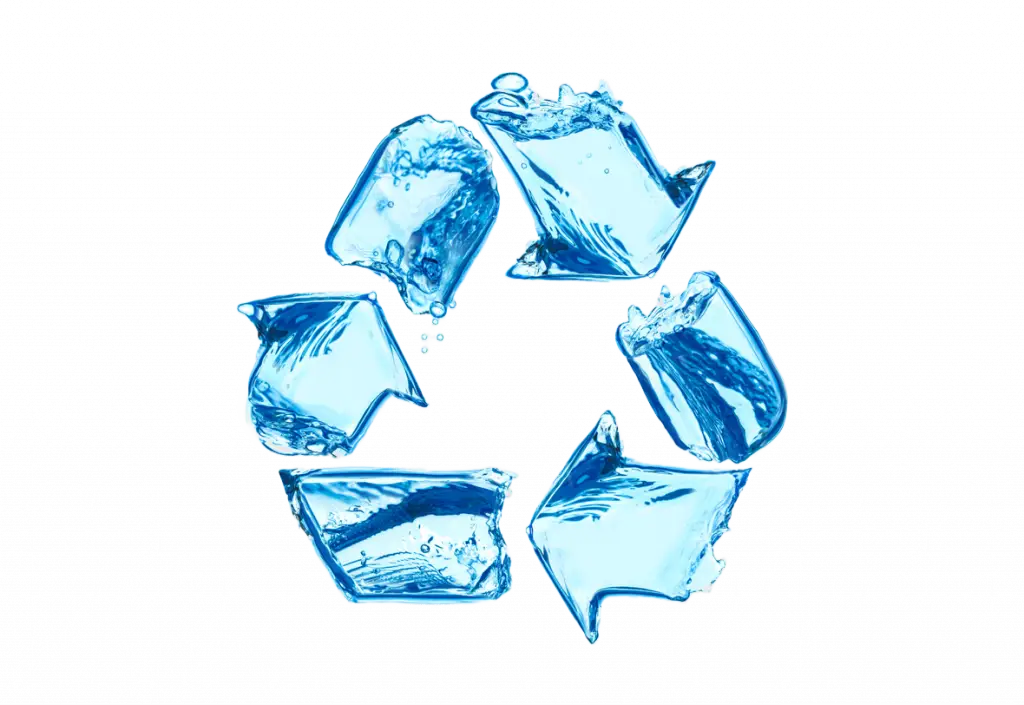
Zero Liquid Discharge (ZLD) offers one of the most effective solutions for almost completely eliminating waste water and recovering valuable process water. The precise interaction of all treatment steps results in a highly efficient recycling concept. Almost 100 % of the waste water becomes recycled process water.
The combination of various recycling and treatment technologies in the cascade creates a closed water cycle – with high operational reliability and significant savings in fresh water and chemicals.
The circulation system
Reduce water consumption and increase process reliability.
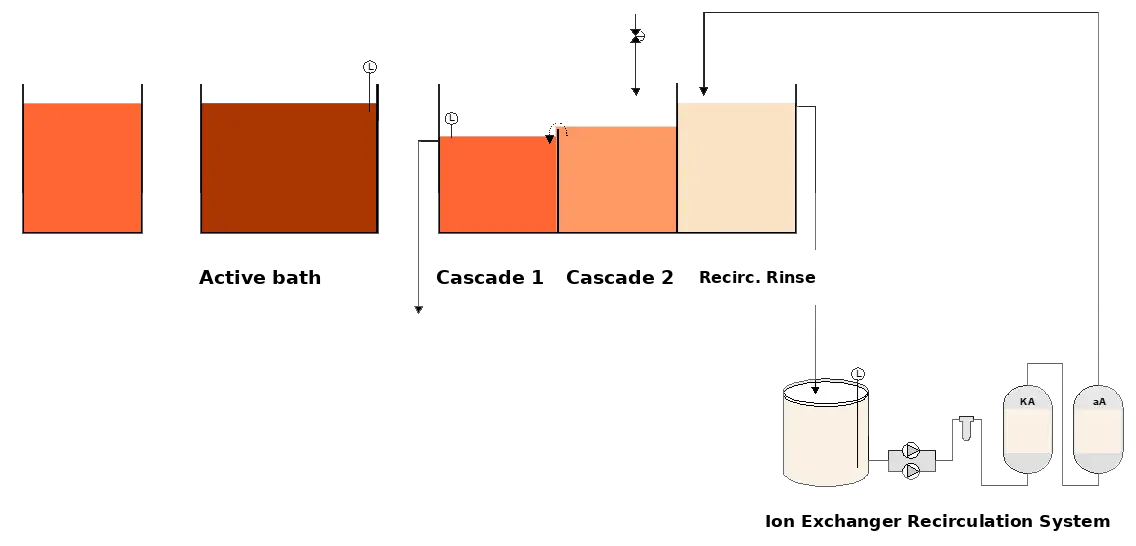
A recirculation system at the last rinse of a cascade rinse in the electroplating plant has several technical, economic and ecological advantages:
1. Significantly reduced fresh water consumption
- The last sink has the least carryover in a cascade.
- The relatively clean rinse water collected there can be easily treated (e.g. using ion exchangers, reverse osmosis or membrane filtration).
- The purified water is fed back into the sink – the system only requires minimal amounts of fresh water to compensate.
2. Minimized wastewater volume
- As the water remains in circulation, there is almost no waste water to be discharged directly.
- Only small quantities of concentrate need to be discharged from the treatment plant.
- Relieves wastewater treatment and reduces operating costs.
3. Higher process reliability and stable rinsing quality
- The water quality in the final sink remains consistently high as it is continuously cleaned via the circuit.
- Lower fluctuations in conductivity and ion concentrations.
- Less risk of back contamination in the previous rinses.
4. Improved product quality
- The final rinse is crucial for cleanliness before drying or further treatment.
- Less staining, better adhesion and higher surface quality.
- Particularly important for high-quality and functional surfaces (e.g. electronics, decorative coatings).
5. Cost savings
- Less fresh water required → lower water costs.
- Less wastewater → lower wastewater costs and fees.
- Reduced consumption of chemicals in wastewater treatment.
6. Ecological advantages
- Sustainable use of resources.
- Reduced environmental impact due to minimized wastewater volume and lower pollutant load.
7. Possibility of recovering recyclable materials
- In some processes (e.g. precious metal electroplating), recycling technology can be used to recover very small quantities of metallic carryover.
- This can be economically relevant.
Who is the circulation system particularly suitable for?
It is ideal for:
- Processes with high rinse water quality requirements
- Applications with sensitive or high-quality surfaces
- Production processes with stable quality specifications
- Company with a focus on process reliability
- Companies with additional savings potential for fresh water
Industry focus:
- Electroplating & surface technology
- Automotive industry & suppliers
- Electronics & printed circuit board industry
- Medical technology
- Mechanical and plant engineering
- Precision mechanics & precision engineering
- Metalworking industry
- Chemical industry & process industry
Zero Liquid Discharge (ZLD)
Maximum water recovery for industrial processes

ZLD stands for maximum water efficiency, maximum regulatory safety and sustainable future viability of industrial processes with numerous advantages:
1. No waste water production
There is no wastewater to be discharged – a discharge permit is not required.
2. Maximum water recovery
Treated water can be fed directly back into existing production processes.
3. High independence from fresh water sources
Reduced need for external and limited fresh water increases the security of supply.
4. Independence from discharge limits
No need to adapt to stricter legal requirements or official regulations.
5. Optional recovery of recyclable materials
Metals or salts can be concentrated and in some cases recovered economically.
6. Stable operating costs in the long term
Protection against rising wastewater charges, discharge costs and regulatory changes.
7. Image and sustainability benefits
ZLD systems strengthen the environmental balance and support a credible “green marketing” strategy.
Who is ZLD particularly suitable for?
ZLD is ideal for companies that:
- generate high volumes of wastewater.
- are subject to strict discharge requirements (e.g. Annex 40).
- want to keep water in circulation.
- in regions with a limited supply of fresh water.
- want to save costs, resources and chemicals in the long term.
Industry focus:
- Electroplating
- Anodized
- Printed circuit board production
- Mechanical processing
- Chemical and electrochemical processes
- Metal and surface technology
Your next step:
Let us work together to find out which recycling or processing system is best suited to your process. Contact us now with no obligation.
Why aqua plus?
Why
aqua plus?
- Over 30 years of industry expertise
More than three decades of experience in water recycling and wastewater technology make us one of the leading partners for industrial process and recycling solutions.
- ZLD systems made to measure
Aqua plus develops zero liquid discharge systems that are precisely tailored to your production processes, wastewater flows and quality requirements.
- Everything from a single source
From analysis, planning and system construction to installation, commissioning and service, we provide you with a complete, turnkey solution package.
- Future-proof system technology
We rely on robust, maintenance-friendly and modularly expandable technologies that guarantee long-term operational reliability and maximum flexibility.
Further services
Plant engineering
MORE DETAILS
Service & AfterSales
MORE DETAILS
Wastewater chemistry
MORE DETAILS
With the recirculation system , the last sink of a cascade sink (the one with the least load) is converted into a recirculation sink. The water therefore runs permanently in a closed circuit, thus saving fresh water. The contaminating metal ions are removed in the process.
This means that the rinsing criterion in the two cascades upstream can be significantly reduced. The final rinsing step is always carried out with the best quality water.